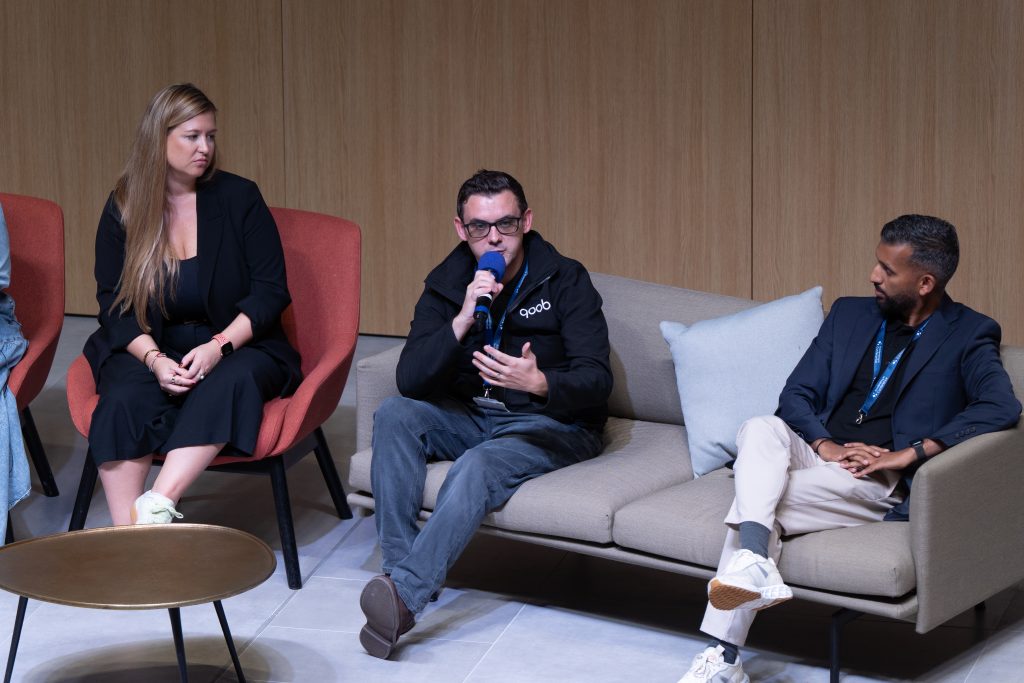
Nearly 300 people, one message on repeat: start with the problem, not the tool.
On Tuesday 13 October, the fifth Accelerating AI conference filled Unity Place in Milton Keynes as part of MK Tech Week. Our first one had about 30 people in the room. This time it was nearly 300: sole traders, manufacturers, lawyers, landscapers, retailers and people from organisations employing thousands.
Accelerating AI is run by Qoob alongside Dragon Information Systems and Fliweel.Tech, and this year’s line-up included Google Cloud, Microsoft, Canva, NatWest and FreeAgent. If you couldn’t make it, or you’re still working through your notes, here are the ideas we think are worth acting on.
Start with the problem, not the AI
This came up in almost every session. Samantha Hunter from the South Midlands Growth Hub put it most bluntly: “Usually AI isn’t the problem. The business is the problem.”
She shared a figure from our Accelerating AI white paper: 63% of businesses surveyed are exploring AI or running early experiments, but only 7.4% have regular time set aside for it. Her five questions before you buy anything are worth pinning up: what exactly is the problem, how much is it worth, could AI genuinely change it, can you do it safely, and what’s the smallest experiment you can run? We dug into the white paper findings in What South Midlands SMEs Told Us About AI Adoption.
Debbie Lewis from NatWest backed this up with the bank’s own research. Only 6% of AI users have reached the most advanced stage, but those businesses save 61% to 70% of working time on the tasks involved, compared with 1% to 10% for early users. Her conclusion: the winners “won’t be the ones who use more of it. They’ll be the ones that use it to solve real customer problems.”
Dr Ed Braund from the University of Bedfordshire added a warning. One organisation rolled out Copilot without training and saw email volume rise by over 200%, with complaints going up too. “We don’t start with AI, we start with process.”
Begin with the jobs nobody wants
Lucy from FreeAgent gave the simplest homework of the day: “List down five jobs you don’t want to do.” Manual, repetitive, low-skill tasks. Write down the steps for each, then ask where connected AI could help. Sometimes the answer is a basic automation rather than a frontier model.
Andy Paul from Fliweel.Tech showed what that looks like in practice. His “to-do agent” runs at 8am, checks his meetings, CRM, inbox and unpaid invoices, and gives him his top three priorities for the day. He called it “super simple, but super transformative”.
Agents are arriving, so set the rules now
Google Cloud described 2026 as the year AI moved “from passive chat to autonomous action”, and the afternoon showed how real that is. Lionel Naidoo from Dragon Information Systems walked through Microsoft’s Copilot stack, from Copilot Chat to Cowork, which can build a board pack or a tender response from your own files. He priced Cowork at around 1p per credit, so a complex task like a board pack costs roughly 50p.
The flip side is risk. Andy demoed a lead-scoring skill that sorted 20 webinar leads into hot, warm and cold in about two minutes, then showed how an inbox agent could be tricked into forwarding password reset emails. “Autonomy without strict permissions, verification and human escalation creates a real serious business risk.”
Lionel’s summary was the line of the afternoon: “Agents take the execution, you keep the agency.”
The security basics still matter
Richard from the Cyber Resilience Centre for the South East reported a 395% year-on-year rise in victims saying AI was used in the attack against them. Big incidents like the Jaguar Land Rover attack often get in through the supply chain, which is where SMEs sit.
He wasn’t there to scare anyone: “I think the value of AI sits in defence.” His advice was Cyber Essentials, proper backups and knowing what your IT provider actually covers. The Home Office funds free support for SMEs through your local Cyber Resilience Centre, including staff training and website testing.
Keep the human in it
Lorna from Canva suggested letting AI take a piece of work “70%, 80%” of the way, then having a person check the brand, imagery and message. Her example was a 100% AI-generated ad campaign that drew a backlash on TikTok that same day.
The panel had a sharper example. An AI-generated image on LinkedIn got 41 views. An authentic video the next day got 12,500.
Ideas become real much faster
Our own Matthew Rigby-White showed how quickly an idea can become something you can hold. With no CAD skills, he had ChatGPT design a branded robot desk buddy, drive the 3D software and set up the printer. “I literally just hit print.” Around 50 of them went home with delegates.
He also pasted a single prompt into Claude at 8am on the day, and by his talk a website for ordering custom robots was live. His point: “Curiosity and creativity can now get an idea into something that’s tangible much more quickly.” Getting from prototype to production still needs security and expertise, which is where a good partner earns their keep. He left the room with three questions to ask your agency:
- What customer problem could we test sooner?
- What experiment are we proactively recommending, and why?
- How will we judge whether it actually works?
What it means for SMEs: 3 things to do this month
- Write your list of five. Pick five jobs nobody wants to do, write down the steps, and choose one to test. We cover how to roll this out in How to Get Your Team Using AI Without the Chaos.
- Pick one tool and learn it properly. As one panellist said, “pick a tool, pick your poison, whether it’s ChatGPT or Copilot or Claude”. Run a 60 or 90-day pilot with a clear measure of success.
- Check your basics before you connect anything. Look at Cyber Essentials and your backups, and decide what any AI tool can access and when it needs a human to approve.
Not sure where AI fits in your marketing specifically? Start with Where AI Fits in Your Marketing (and Where It Doesn’t) or 5 Ways SMEs Are Using AI in Marketing Right Now.
Thank you
A huge thank you to everyone who came, and to our host Kerry Lewis-Stevenson from Business MK. Thanks also to our speakers and supporting partners, including Google, Microsoft, Canva, NatWest, FreeAgent, Zoho, the University of Bedfordshire, British Business Bank, MK City Council, techUK, the South Midlands Growth Hub and the Cyber Resilience Centre. Thank you to Unity Place for looking after us all day.
What’s next
The next Accelerating AI conference is on 15 April 2027 at Unity Place. We’ve also launched the Accelerating AI Mastermind: 10 business owners, one day a quarter for 12 months, each ending with a 90-day plan. Details are on acceleratingai.co.uk.
Book a free chat about AI in your marketing
If the day left you with ideas but no clear first step, we can help. Book a free AI ideas session with Qoob and we’ll look at where AI could remove friction from your marketing and website, then send you a recap. No commitment. Talk to us.